Written off, but far from worn out: the long lifespan of EMS equipment
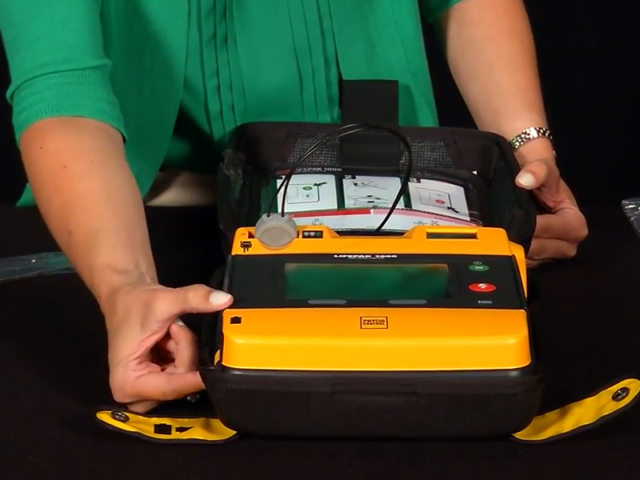
A LIFEPAK 15 can bounce over speed bumps in an ambulance for years, be used outside in the rain, and survive a heavy drop. The monitor is literally designed for it. Yet, after five to eight years, that exact same device can be retired from an ambulance fleet while still functioning flawlessly from a technical standpoint.
That might seem contradictory, but it isn’t.
Professional EMS equipment actually has more than one lifespan. There is an organizational lifespan, determined by new technology, risk management, standardization, and replacement cycles. And there is a technical lifespan: how long a device can continue to operate safely and reliably when properly maintained.
Particularly with high-end ambulance equipment, those two can diverge significantly.
It starts with the way this equipment is designed. A monitor, ventilator, or stretcher for pre-hospital care must function for years in conditions that have little in common with a hospital ward. Drops, vibrations, moisture, temperature fluctuations, and intensive daily use are simply part of the job.
And it is precisely that robustness that enables something else: a second life.
Built for a rugged environment
An ambulance is a demanding environment for medical equipment. During a ride, a monitor constantly absorbs vibrations and movement. Minutes later on scene, that same device might end up outside on the street or next to a patient on a narrow staircase.
That is not an exceptional situation. It is the normal working environment.
Specific technical requirements exist for a reason. IEC 60601-1-12 addresses the safety and essential performance of medical electrical equipment intended for use within EMS. In the guidance notes of the standard, the pre-hospital environment is explicitly described as an uncontrolled and rugged environment. The requirements are intended for equipment taken to an incident scene and used both on-site and during transport.
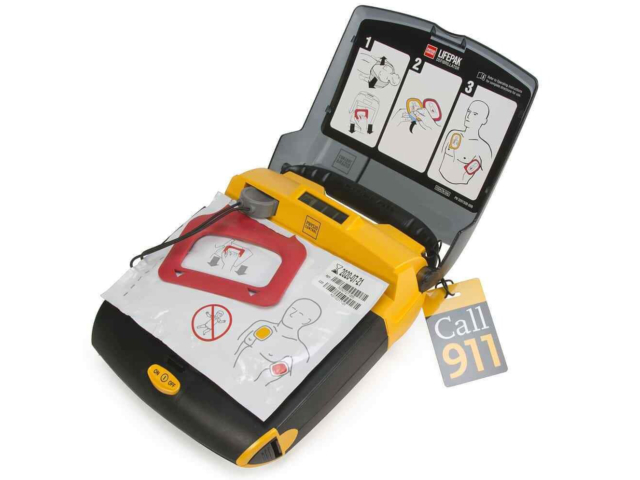
How seriously manufacturers take that load becomes clear when looking at the LIFEPAK 15.
According to official specifications, the monitor withstands five drops on each side from approximately 46 centimeters onto a steel surface. Additionally, Stryker specifies compliance with EN 1789, including a drop test from approximately 76 centimeters on each of its six sides.
It doesn’t stop there. The LIFEPAK 15 is subjected to three functional shocks per side of 40 g and a test featuring 1,000 impacts at 15 g. For vibration, profiles are specified for road transport, helicopters, and propeller aircraft. During operation, the device carries an IP44 rating under the manufacturer-specified configuration.
These are not features needed simply to capture an ECG.
They are necessary to keep capturing that ECG reliably after the device has lived the life of an ambulance monitor for years.
This also explains a significant portion of the high purchase price of professional EMS equipment. A monitor costing tens of thousands of euros isn’t just expensive because it can monitor, pace, and defibrillate. It must continue performing those functions while constantly exposed to conditions that standard electronics are barely designed to endure.
Robustness is not just in the electronics
This design philosophy is not limited to monitor/defibrillators.
A great example on the other end of the technical spectrum is the paraPAC 200D. This transport ventilator comes from a generation where simplicity is a major strength. The controls are direct and the system is heavily pneumatic. No large touchscreen or elaborate digital interface, but a device primarily built to deliver reliable ventilation during transport.
With stretchers, the same philosophy becomes mechanically evident.
The Stryker M-1 6100 is a fully manual ambulance stretcher with a maximum weight capacity of 227 kilograms. It is a heavy-duty system developed specifically for pre-hospital and hospital environments.
For me, the M-1 ranks among the absolute top of manual ambulance stretchers. The build quality is exceptionally high. Especially with older units, you see just how far such a construction can go: a frame can bear clear signs of years of use while the technical foundation remains excellent.
Interestingly, Stryker specifies an expected service life of five years for the M-1 under normal use and appropriate periodic maintenance. However, such a manufacturer timeline does not mean every unit suddenly wears out technically on its fifth anniversary. The actual condition of an individual product remains dependent on usage, maintenance, wear, and technical evaluation.
A LIFEPAK 15, paraPAC 200D, and Stryker M-1 are three completely different products—electronic, pneumatic, and mechanical. Their common ground lies in the design philosophy: high-grade professional equipment built for a tough daily life.
Old is not the same as worn out
Anyone who works with used ambulance equipment immediately recognizes a device that has worked hard. Bumpers get damaged, housings get scratched, wall mounts wear down, and paint disappears at contact points. On stretchers, usage shows on frames, wheels, and latching mechanisms.
That is normal for equipment that has seen active service.
However, visible wear and technical wear are not the same thing. A damaged bumper may have done exactly what it was designed to do: absorb an impact before it reached the internal electronics. Conversely, a cosmetically pristine monitor can still have an internal defect.
The same applies to age.
Two LIFEPAK 15 units from the same manufacturing year could have lived completely different lives. One may have served for years as the primary monitor on a busy ambulance, while the other was used mainly as a backup unit.
Age naturally plays a role. Components age and mechanical parts wear down. But the manufacturing year alone reveals little about the actual condition.
Usage intensity, maintenance history, technical state, software version, battery health, calibration, and functional testing together provide a far clearer picture.
That is precisely why professional EMS equipment remains compelling after its initial operational cycle.
Why replace something that still works?
Ambulance services do not have to wait until equipment is literally worn out before replacing it.
In fact, there are solid reasons to replace equipment earlier.
Risk management plays a key role. An organization requires predictable maintenance, readily available spare parts, and adequate technical support. At the same time, technology evolves. Newer generations may offer improved connectivity, new diagnostic parameters, faster data transmission, or other features critical to the organization.
Standardization is another major factor. For a large ambulance service, maintaining a single uniform platform across the entire fleet can be far more advantageous than operating mixed generations. Training, accessories, vehicle mounts, spare devices, and servicing can all be streamlined.
For public organizations, budget allocations and procurement cycles also dictate timing. Replacing a fleet after five to eight years can make complete sense for the original user, even when a portion of the equipment remains in great working order technically.
Therefore, it is no contradiction for an ambulance service to procure new equipment while the outgoing equipment still retains substantial value.
For the primary user, the organizational lifespan may have ended. The technical lifespan doesn’t have to be.
And that is where the potential for a second life begins.
From used to refurbished
Not every device coming out of an ambulance is automatically suited for redeployment.
There is an important distinction between simply “used” and professionally refurbished.
Cosmetic work is the most visible aspect. A device is thoroughly cleaned, damaged housing parts can be replaced, and the exterior is restored where necessary. This ensures the equipment looks presentable and professional again.
However, the true value of refurbishment lies in the technical verification.
Functions are thoroughly tested, measured values checked, and calibrated where necessary. Software can be updated, batteries and wearable parts evaluated, and required repairs executed. Depending on the brand, device type, and scope of work, specialized service may be carried out by the manufacturer or an authorized service provider.
Following service and testing, proper documentation is provided to verify the performed work and test results.
It is comparable to the difference between buying a trade-in used car vs. buying that same car after a comprehensive service, technical inspection, and necessary preventive maintenance.
The year of manufacture doesn’t change. The condition and the confidence in what you buy do.
With medical equipment, this distinction is even more critical. Merely turning on a monitor is not enough. The key question is whether the functions and values a clinician relies on have actually been verified.
Not every device deserves a second life
Refurbishment also does not mean keeping old equipment alive at all costs.
There comes a point where continued deployment is no longer technically or economically viable. Critical spare parts may become unavailable, repairs too costly, or manufacturer support may end altogether. Severe internal damage can also render a device unsuitable for refurbishment.
That is why selection is crucial.
A twelve-year-old device might prove to be an excellent candidate after inspection. A six-year-old unit, on the other hand, might be unviable due to extreme operational abuse or an expensive internal failure.
The question is not just: How old is it?
The better question is: What is its technical condition, what has it been through, and how much reliable operating life remains?
For equipment engineered from the drafting board for demanding professional use, the answer can often be surprisingly positive.
Europe is increasingly looking at second life cycles
Alongside technical and economic factors, another argument has entered the spotlight: sustainability.
A professional monitor, ventilator, or stretcher represents a significant investment in raw materials, energy, and manufacturing expertise. Electronics, metals, high-grade plastics, and precision components are already produced and integrated into a product specifically built to last.
If such a device remains technically viable for years to come, refurbishment prevents that built-up value from going to waste prematurely.
This perspective is becoming increasingly concrete at the European level.
On September 9, 2026, the European Commission presented a proposal for a new Public Procurement Act. Article 51 explicitly grants public buyers room to incorporate criteria that promote circularity and efficient resource use across the entire product lifecycle during tenders.
These criteria explicitly cite durability, repairability, upgradability, reuse, and refurbishment. Notably, the proposal goes a step further by explicitly mentioning the procurement of refurbished, remanufactured, and pre-owned products.
While currently a legislative proposal—and not yet a mandatory requirement for European ambulance services or public buyers—the trajectory is clear.
The debate is shifting from solely asking which new product to purchase to examining how products can be maximized across their full lifecycle.
For EMS equipment, this is exceptionally relevant. This sector relies on high-value professional assets built for years of heavy service. When a device remains technically sound after its first operational cycle, entering a second life phase makes compelling sense—both economically and ecologically.
Buying new and deploying refurbished are not mutually exclusive. A large ambulance service may have sound reasons to transition to a new platform, while the released equipment can continue to deliver value elsewhere for years to come.
Conclusion
The extreme build quality of EMS equipment exists for a reason.
A LIFEPAK 15 is not tested against drops, shocks, and thousands of impacts just to look impressive in a brochure. It is tested that way because a pre-hospital monitor must operate dependably for years under conditions where taking hits is unavoidable.
In a paraPAC 200D, that durability resides in a relatively simple and robust pneumatic construction. In a Stryker M-1, the same principle manifests as heavy-duty mechanical engineering.
Because of this design philosophy, the technical lifespan of premium EMS equipment often extends well beyond its initial operational cycle.
An ambulance service may have valid reasons to refresh a fleet after five to eight years. Emerging technology, risk management, standardization, and organizational policy can fully justify that investment. But that does not render the existing equipment inherently worn out.
That is why a manufacturing year tells only part of the story.
Technical condition, operational intensity, maintenance history, parts availability, functional testing, and calibration paint a far accurate picture of true value. If that foundation is sound, professional refurbishment is a logical next step.
As lifespan, repairability, reuse, and refurbishment become central to public procurement policy in Europe, that second life cycle will only grow in importance.
For its first owner, a device may have completed its mission.
That doesn’t mean the device itself is done.
Need advice on replacing your EMS equipment?
The team at Diac Medical is happy to help you choose the right successor for your situation and budget. Explore our current inventory of EMS equipment or contact our specialists directly for no-obligation advice.

With over 15 years of experience at Diac Medical, Jesse knows everything there is to know about Ambulances and Medical Ambulance Equipment. He likes to share his knowledge and experiences.